
Start with the footwear application
A shoelace is part of a fastening system. Its performance depends on the lace body, eyelets or loops, aglets, lacing path, knot, footwear material and wearer behavior. A material claim or yarn strength result does not automatically predict how the complete lace will work in a finished shoe.
Describe the application: athletic, outdoor, work, casual, children’s or fashion footwear; the expected lacing pattern; lace length and width; number of eyelets; and the environment in which the shoe will be used. Note whether the lace must stay tied, slide through eyelets easily, stretch, resist abrasion or provide a visual feature such as reflective yarn. These priorities can compete, so buyers should set the order of importance.
Define the product by its construction and measured dimensions rather than color alone. Identify whether the lace is flat, round, braided, woven, elastic, waxed or made with a composite yarn. Ask the supplier to confirm the material composition, cross-section, width or diameter, thickness, length tolerance and mass if relevant. Specify how length is measured and whether it includes the tip.
For a new style, share the footwear pattern or eyelet spacing and approve a sample laced through representative hardware. A lace that is too thick, slick, narrow or stiff can change knot behavior, eyelet friction and the effort required to tighten the shoe.
Compare lace constructions
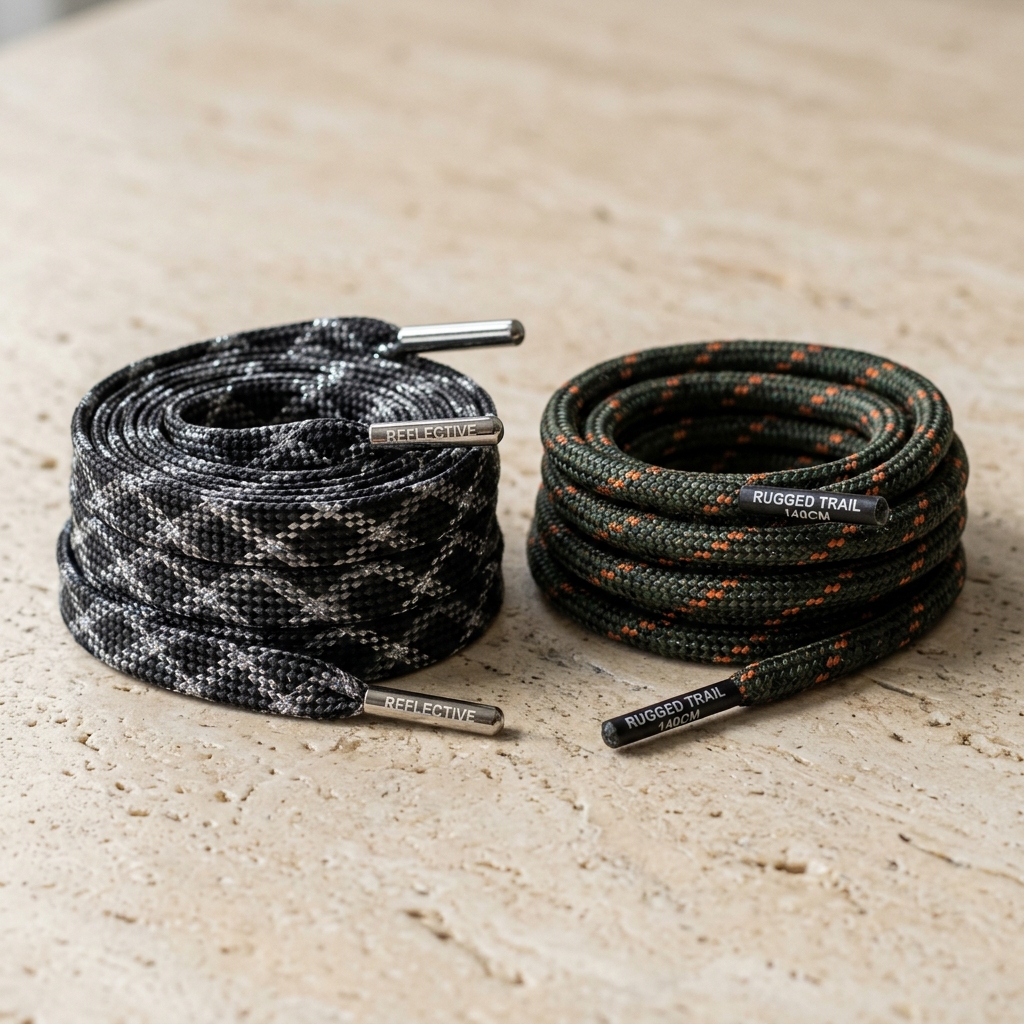
Flat woven laces can provide a broader contact area and support color patterns or printed details. Round braided laces can suit boots or outdoor shoes where a rounded profile is desired. Braided and woven structures can differ in extension, surface texture and resistance to fraying. Elastic laces add stretch, which may help some applications but can alter tightening and fit. Waxed or coated surfaces can change appearance and friction, and may require compatibility checks with cleaning or wear conditions.
Fiber selection alone is not enough. Yarn size, weave density, braid pattern, core, surface finish and finishing process affect the final lace. A recycled polyester yarn, cotton yarn or mixed construction should be named in the specification with its intended share and evidence requirements. Do not assume a recycled-content certificate proves tensile strength or durability.
Ask for side-by-side samples that share the same length and color family when comparing constructions. Record the lace body dimensions, hand feel, stretch, surface finish and knot behavior using the same lacing and knot procedure. Include the intended eyelet or hook type because sharp edges, burrs or a small radius can accelerate wear.
Reflective yarn, printed stripes or decorative threads can change the hand and surface. Review whether added elements remain attached after the tests relevant to the project and whether they affect the brand’s visibility claims. Use approved artwork and specific lighting or viewing conditions if reflectivity is part of the brief.
Specify tips and interfaces
Aglets protect lace ends and help them pass through eyelets. They can be molded from polymer, formed from metal or created by another finishing process. Specify the tip material, color, shape, length, diameter, finish and branding. Confirm that the tip fits through the smallest eyelet in the footwear and remains attached to the lace after repeated handling.
The interface between lace and hardware is a wear point. Share the inner diameter, edge profile and finish of eyelets or hooks where available. Check the lace against the actual component because a polished drawing may omit burrs, coating buildup or shape variations that affect friction. For high-friction use, include abrasion review at the lacing contact points and inspect both the lace and hardware after testing.
For a heat-sealed or molded tip, confirm how the bond or closure is formed and what visual defects are acceptable. For a metal tip, identify the finish and any surface contact requirements. If a branded aglet is used, review the artwork, orientation, character limits, small-part geometry and trademark permissions before tooling.
Specify the assembly as one product: lace body plus tip, and, where needed, the eyelet or hook interface. Keep a reference sample, drawing revision and material list so color and fit changes can be approved deliberately.
Choose relevant tests
Testing should answer a defined buyer question. ASTM D2256/D2256M describes a method for tensile properties of yarns in single-strand form; it does not by itself specify a universal finished shoelace acceptance limit. A yarn result may help characterize an input material, while a lace-level or assembly test may be needed to evaluate the product the buyer is purchasing.
Agree the specimen and procedure with the laboratory. For tensile work, record whether the specimen is straight, knotted or looped, the conditioning, gauge length, loading rate, number of specimens and reporting units. For abrasion, identify the contact surface, movement, load, cycles and failure definition. For colorfastness, name the exposure and evaluation scale. Use current standard editions and confirm the method is appropriate to the lace construction.
Check knot security using a repeatable knot, lace tension and footwear configuration. A highly polished lace may slide while a rougher surface may improve friction but increase wear. Keep the procedure consistent and record observed loosening, fraying, tip separation, breakage and color change. Results should be tied to a sample ID and specification revision.
Do not publish a strength value, cycle life or compliance statement without a report that identifies the tested item, method, conditioning and result. A test on one lace construction should not be generalized to every color, width or material option.
Write the lace RFQ
Provide the style reference, application, target length and dimensions, material preference, color, pattern, tip design, logo artwork, annual estimate and destination market. Attach the footwear eyelet or hook details and state whether the lace is expected to be elastic, reflective, recycled-content or water-repellent. Identify the required claim and the document evidence needed to support it.
Ask the supplier to return the proposed construction, material composition, tolerances, available sample options and limitations. Separate tests on yarn, lace and finished assembly. Set acceptance limits with the footwear brand or laboratory, and ask the supplier to quote development samples and production options only after the scope is clear.
During approval, record the sample length, body dimensions, tip construction, color reference, measured material, test report and drawing revision. Production control should include comparison to the approved sample and change notification if the yarn source, weave, finishing or aglet changes.
- Footwear type, lacing layout and eyelet/hook reference
- Lace construction, material, length, width or diameter
- Color, pattern, reflective or recycled-content claim
- Aglet material, finish, dimensions and branding
- Relevant test method, specimen and acceptance criteria
- Sample approval and change-control expectations
Buyer questions
Does a yarn tensile result prove the finished shoelace meets my requirement?
Not necessarily. The yarn method measures yarn properties. Define whether the buyer needs yarn, lace or finished assembly testing.
Which lace is strongest: flat woven or round braided?
Construction alone does not determine strength. Compare the specified samples under the same agreed test method.
Should lace length include the aglets?
State the measurement convention in the specification and have samples checked against it.
Can recycled content and performance be verified with one certificate?
Usually these are different evidence questions. Keep material traceability and performance testing separate.
Always check the current edition and applicability with the issuing organization and the project compliance owner.
Need an item-specific review?
Send the product family, drawing or reference, intended application, target market and required evidence. Availability, specifications, samples, pricing and timing are confirmed for the selected project.
Send an RFQ for this guide’s product family →